
19 October 2026
When viral infections alter the morphological integrity of brain neurons
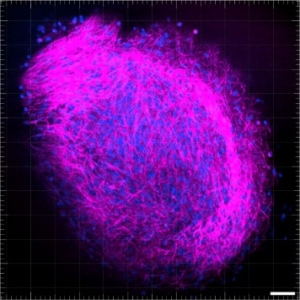
Raphael Gaudin’s team recently published a study in Nature Communications reporting that infection with the poorly studied orthobunyavirus Tahyna virus (TAHV) alters neuronal morphological integrity and the proteome of human cerebral organoids, notably affecting the expression of several synaptic proteins. In organotypic cultures of human brain slices, TAHV infection induces neuronal hyperexcitability, while expression of the metabotropic glutamate receptor mGluR1 is increased in the brains of infected mice. Using an in silico screen based on the perturbome of infected organoids, the team identified gabapentin, a neuromodulator already used in clinical practice, as a candidate for restoring normal neuronal excitability.
This work was conducted through international collaborations at the intersection of several disciplines, including virology, neurobiology, proteomics, artificial intelligence, bioinformatics, and therapeutic discovery. Our findings highlight that arboviruses previously considered harmless may, in fact, interfere with normal brain function. Furthermore, our approach provides an innovative experimental framework for discovering new therapeutic strategies to alleviate neurological symptoms induced by viral infections.
Gorda B, Bouget J, Saini V, Lutz W, Hirschler A, Almeida GM, Brychka D, Bernou C, Partiot E, Delalande F, Sinha P, Parmar HS, Desagher S, Ganesh G, Jha HC, Colomb S, Carapito C, Gaudin R. “Pharmacological targeting of bunyavirus-induced synaptic impairment prevents neuronal hyperexcitability” Nat Commun. 2026 Sep 1;17(1):10426. doi: 10.1038/s41467-026-77284-8. PMID: 42823442; PMCID: PMC13631317.